The misunderstood reality of ARFID and why tiny food victories matter.
Originally on my Substack
A toothpick with a pea-sized piece of chicken made it into my teenage son’s mouth (diagnosed with ARFID) this week, and I stood there watching out of the corner of my eye in utter joy and excitement. What did I do? Literally nothing except take note. He finished his buttered spaghetti pasta, passed on the watermelon because it was too light in color, and then left the empty toothpick in the bowl as if to reinforce that he had eaten it. He grabbed his two-dish requirement, placed them into the dishwasher, and quietly walked away.
ARFID is an interesting eating disorder. It is not based on body image or even simply liking or disliking food, but rather an inability to eat certain foods. As a child, I remember struggling with food as well. I was unable to eat much of anything, really. The feeling and sensation of crunchy textures outside of crackers felt alarming and usually ended with me crying and spitting out the food. At that time there was no diagnosis, and I am not even sure if I would have been considered an ARFID kid.
As I grew up, I remember the firsts: the first time I tried steak and liked it, the first time I tried creamy pesto pasta, and the first time I ate sushi. Before culinary school, I remember a friend taking me to a sushi restaurant because she could not believe I had never tried it. She had her dad’s credit card and insisted on paying for our meal and ordering all of her favorites for me to try.
I had never even heard of sushi. Can you imagine? As California kids in 2026, it is now my kids’ weekly delivered food.
I remember the California roll being dropped at our table and the sweat pooling on my brow. I could not imagine that I was going to have to eat that strange-looking food. I did not recognize anything in it. I watched as she poured soy sauce into her bowl and thought, finally, something familiar. I copied her.
She opened her chopsticks, grabbed a roll, dipped it, and put the whole thing into her mouth. So many thoughts swirled through my head. How was I supposed to eat that in one bite when my bites were typically fit for a mouse?
I sat there for an uncomfortable amount of time before she finally asked, “Are you going to eat it?” Based on my body language, she was convinced I was not.
But I was a determined kid who never wanted to back down from a challenge, even if it meant eating this awful, non-food-looking thing. I fumbled with the chopsticks, plunged the California roll into the soy sauce, and shoved it into my mouth. All I could think was, thank God it mostly tasted like the salty soy sauce I had drowned it in.
She asked, “Well? Do you like it?”
I nodded convincingly, or so I thought.
I took a deep breath. I did it. And now she expected me to eat another one.
I managed to get down three of the five pieces and felt victorious until she asked, “Are you not going to eat the others?”
All of my effort seemed to go unnoticed.
Now, years later, as I watch my son look intently at food before eating it, I understand deeply the stress, nervousness, and bravery it takes to overcome the fear of a new food.
I met Arfid Andrew a little less than a month ago after a friend recommended his channel to me. I watched his content, well, devoured his content. He was facing all of his food fears with laughter and joy to millions of people.
I already had plans for my next set of videos, but when Andrew and I started talking, we decided to collaborate. He was down to cook whatever I had planned. Little did I know, he hates salsa of any kind. He had deemed them enemy foods.
This week’s videos centered around mango salsa.
My first step was to have him touch and prep the food, and when you watch the video, you can visibly see how uncomfortable he is. It is not an act. He is genuinely uncomfortable touching the food. As we stood together and he fidgeted with nerves, I handed him a towel to play with.
We worked from most comfortable to least comfortable, and as he dissected his comfort level, he was completely honest. Touching jalapeños, bell peppers, lime, and mango was not easy for him. It is subtle but noticeable. When he touches the red bell pepper, he scoots it across the cutting board after touching it. It is such a small action, but it really showcases his anxiety.
Nevertheless, we got through all of the ingredients, and he was able to mix everything together.
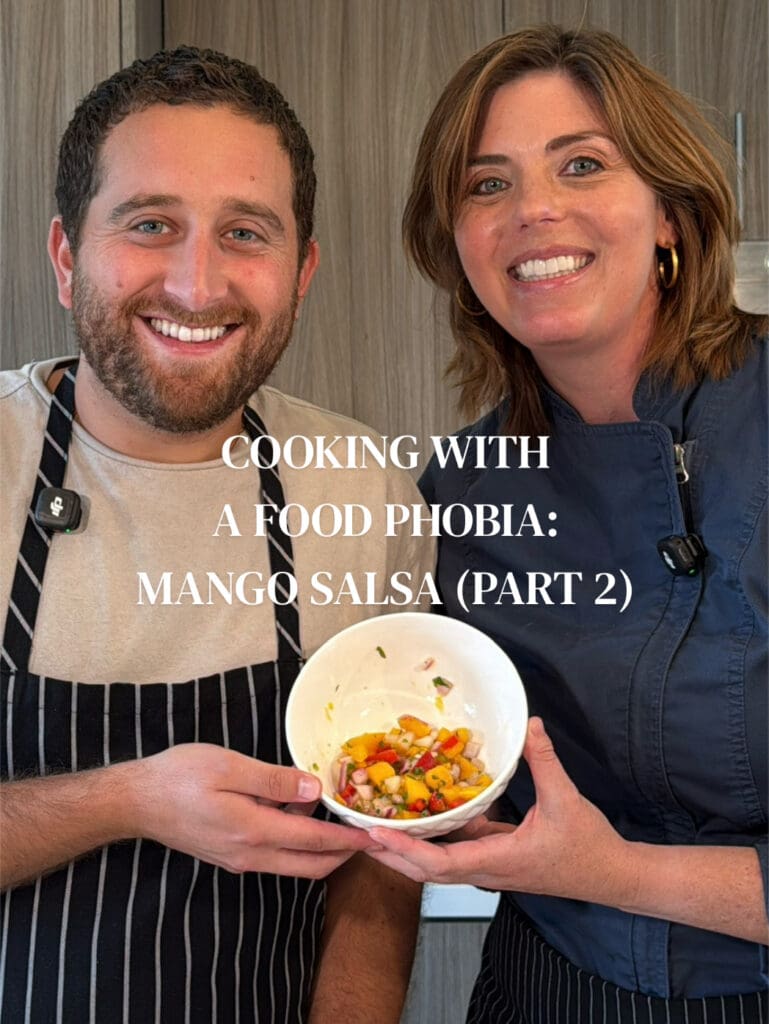
When it came time to eat it, I honestly was not sure he was going to be able to put it in his mouth. He scooped a bit onto a spoon, paused for a moment, and then put it into his mouth. It came right back out with a smile and a laugh. He said the texture was so difficult for him.
After the camera stopped rolling, we cheered because we knew that was massive. We were all very aware that he might not eat it at all. Sometimes food is so stressful that it never even makes it into his mouth, much like with my teenage son.
Andrew has helped illuminate so much about ARFID. He does not carry the shame that so many people do. It is beautiful that he is able to share his story and experiences, especially for people like me, who were possibly undiagnosed with a very mild version, and for my son, who has not yet reached the stage of laughter and joy. For him, it still feels difficult and sad at times, which is why that empty toothpick felt so monumental. It was a moment that I knew made him feel proud, but quietly and privately.
Please check out my latest video with Arfid Andrew, and if you have a friend or loved one with ARFID, please share my story. Let’s open up the conversation about ARFID.
